Summary of the Biomaris study
The IPBES identifies 5 drivers of biodiversity decline worldwide: climate change, pollution, land and sea use change, depletion of species and invasive alien species [1] [*].
The Biomaris method takes into account the effects of biotic resource depletion and seabed disturbance. Applied to a case study of saithe (Pollachius virens) fished in the North-East Atlantic, the results show that these two pressures can have a significant impact on ecosystems.
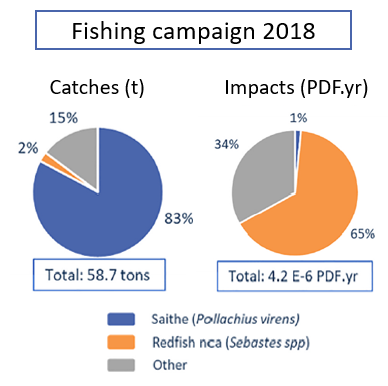
The fishing of threatened species, by-catch of saithe fishing, has a predominant impact. This is the case for the Great Redfish (Sebastes norvegicus), a vulnerable species in Europe on the IUCN red list, which during the 2018 campaign represented just 2% of catches but 65% of impacts (Figure 1). Thus, the impact of biotic resource depletion is of the same order of magnitude as that of climate change and pollution on saithe production.
With regard to the impact on the seabed, two factors are of particular importance:
- Trawling in vulnerable areas (deep areas with fragile environments such as coral).
- Trawling a large surface area per kg fished (low trawl yield).
On the other hand, when fishing for a sustainable stock, impacts on the seabed appear to be dominant. These conclusions remain provisional, as although they are expressed in PDF.year (Potentially Disappeared Fraction of species during a year), the scope of this unit may vary between pressures (local, regional or global disappearance of species).
We can help you measure and reduce the impact of your fishery and aquaculture products on biodiversity, taking into account the depletion of fishing resources and the degradation of the seabed by dragging gear. To find out more about our added value, take a look at our offer: biodiversity footprint!
Would you like to find out more about our work? The publication is available here!
[1] IPBES, Global assessment report on biodiversity and ecosystem services of the Intergovernmental Science-Policy Platform on Biodiversity and Ecosystem Services; Brondizio, Eduardo S; Settele, Josef; Díaz, Sandra; Ngo, Hien T. 2019.
[*] Life Cycle Assessment (LCA), the method commonly used to evaluate a product’s impact on ecosystems, does not cover all pressures. Indeed, invasive alien species and the depletion of species are not currently covered by LCA. Land and sea use change is only partially covered at terrestrial level, and not at all at marine level.
 Member of the European PEF (Product Environmental Footprint) Technical Advisory Board.
 Member of the French ADEME environmental labelling working group.