Product Biodiversity Footprint “PBF”
A new approach combining multiple disciplines to design products that are more respectful of nature and ecology

The impacts of products on the quality of ecosystems are partially taken into account by life cycle assessment (LCA), a recognized and standardized method for calculating environmental footprints.
However, LCA methods do not cover the 5 drivers of biodiversity loss identified by the Millennium Ecosystem Assessment, 2005 (MEA) ref or more recently by the IPBES (2019) ref study: only land use and land transformation, pollution and climate change are covered, while over-exploitation of species and invasive alien species are not. In addition, ecologists work in the field to measure the concrete impacts of practices and technical itineraries, in particular on the production of agricultural materials: they are able to give indicators of the number of species (richness) or the number of individuals of each species (abundan ce) according to the different practices: bio agriculture reasoned, integration of hedges, beehives, …
The Product Biodiversity Footprint (PBF) approach aims to bridge the gap between LCA and ecology. Its objective is to enable the comparison of variants of a given product to inform eco-design, addressing the five drivers of biodiversity loss as defined by the MEA. The methodology combines LCA and current ecological knowledge and organizes them into indicators and practical representations. It
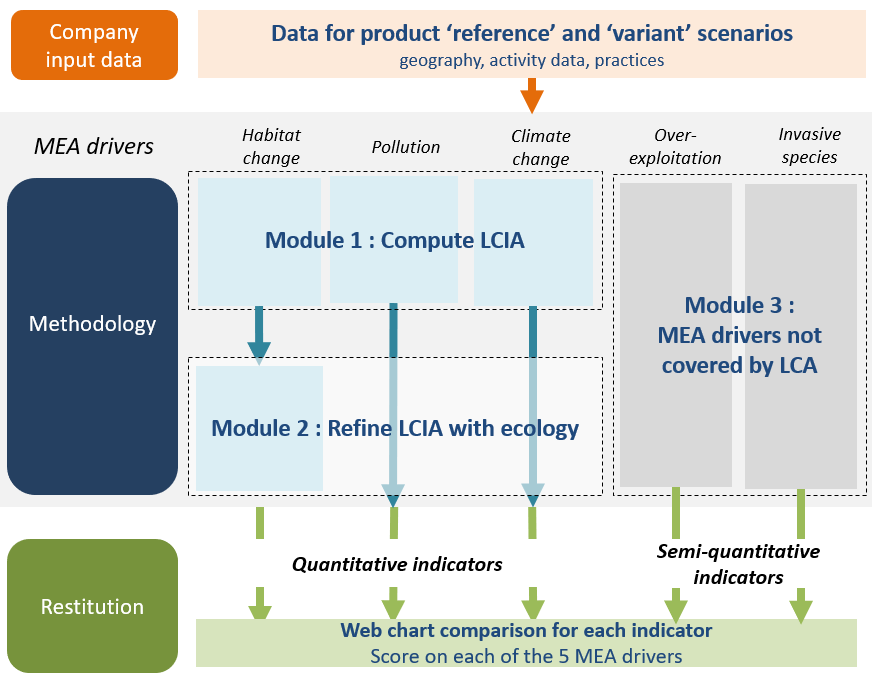
Simplified architecture of the methodology and the tool presenting the company’s input data, calculations and restitution with quantitative and semi-quantitative indicators.
EBP was tester in three company case studies.

This product-level method is, to our knowledge, the first to cover all five MEA drivers along the value chain, with a combination of quantitative and semi-quantitative indicators. Based on a global LCA framework and approach, ecological knowledge provides qualification elements to refine the information.
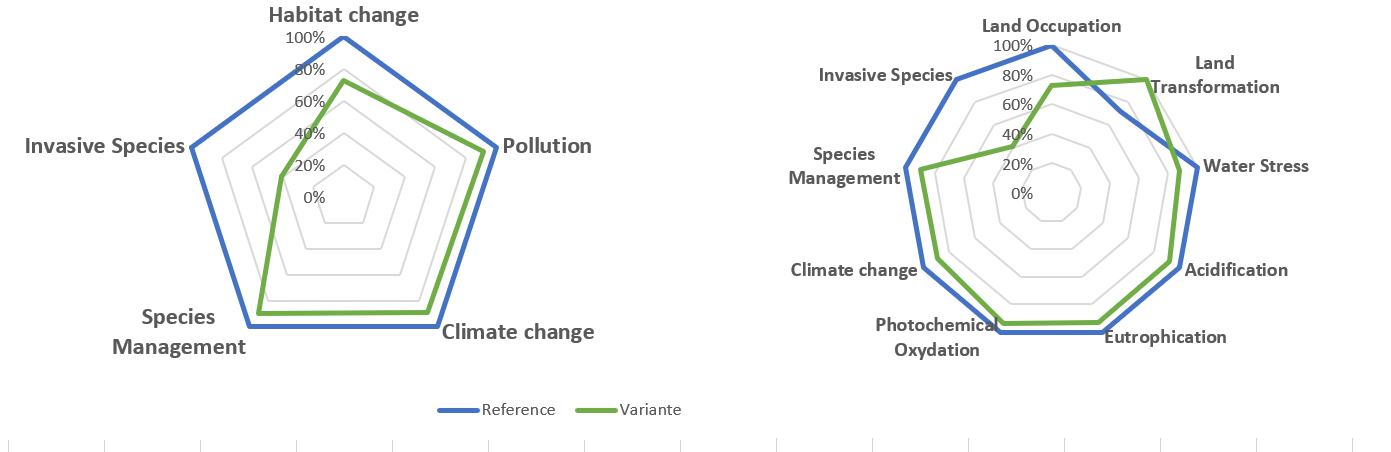
In particular, the restitution can take the form presented below on a fictitious example. On the left is a summary of the impacts on biodiversity of a reference product and a variant based on the 5 pressures of the MEA. On the right, the detail according to the different impact chains.
1 Millennium Ecosystem Assessment. (2005). Ecosystems and Human Well-being: Synthesis. Washington, DC.
2 IPBES (2019): Global assessment report on biodiversity and ecosystem services of the Intergovernmental Science-Policy Platform on Biodiversity and Ecosystem Services. S. Díaz, J. Settele, E. S. Brondízio E.S., H. T. Ngo, M. Guèze, J. Agard, A. Arneth, P. Balvanera, K. A. Brauman, S. H. M. Butchart, K. M. A. Chan, L. A. Garibaldi, K. Ichii, J. Liu, S. M. Subramanian, G. F. Midgley, P. Miloslavich, Z. Molnár, D. Obura, A. Pfaff, S. Polasky, A. Purvis, J. Razzaque, B. Reyers, R. Roy Chowdhury, Y. J. Shin, I. J. Visseren-Hamakers, K. J. Willis, and C. N. Zayas (eds.). IPBES secretariat, Bonn, Germany.
 Member of the European PEF (Product Environmental Footprint) Technical Advisory Board.
 Member of the French ADEME environmental labelling working group.